

Too many talented people resign themselves to grinding in jobs that drain them, convinced they have to choose between passion and pragmatism.
Just look at the depressing comments on Adam Mastroianni’s article on embracing your craziness. Talented people arguing themselves into tepid resignation:
“Young people are constantly being told to find their passion etc etc but when you are 40 and can’t afford to buy a house you start caring less about how fulfilled you are at work and more about how much you can earn…”
“Depending on something you enjoy doing to pay your bills is a great way to learn to hate that very thing, which is a shame.”
“Work which needs to be done is not unique and will never be… Instead, one should find a work which he can do well, and embrace craziness in his personal life.”
“There’s fun, there’s rewarding, and then there’s ‘worthy of monetary reward’. Guess which one doesn’t fit.”
They’re wrong.
Because nobody teaches them the alternative.
The Problem: We Default to One or the Other
Take this comment from Russ Wilde, who got more 109 likes for his two cents:
“Many people, me included, will eventually have to choose between what they enjoy and what they are good at. I enjoy making music and can spend hours playing guitar. After 40 years of practice, I am almost good enough to play in the worst imaginable bar cover band. However, I am a fairly good professor and academic administrator, but it’s been a daily grind. My aptitudes and interests have never been a great match.”
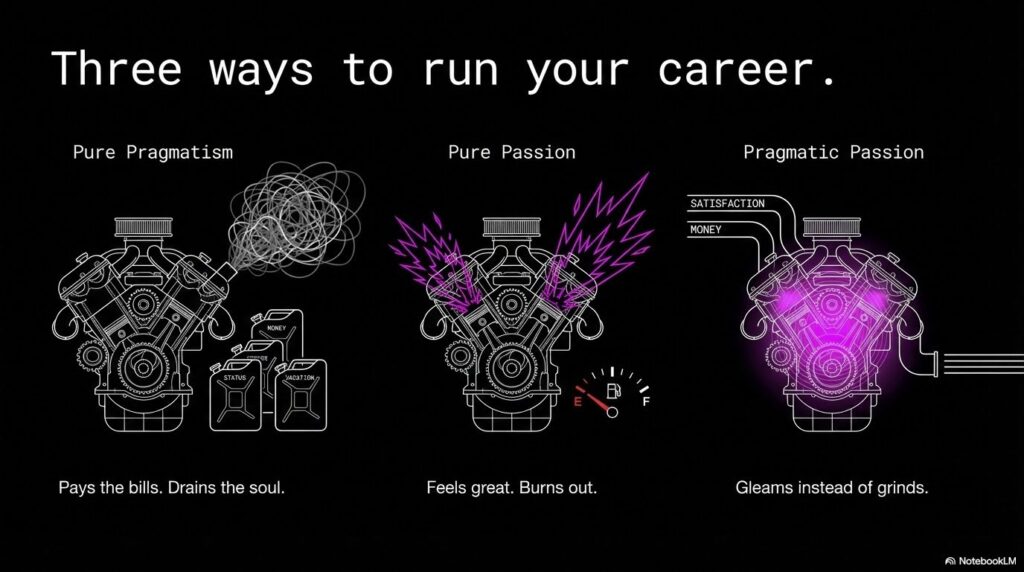
These are the dirty mechanics of pure pragmatism: shove your engine into a “safe” career, ignore what actually fires your cylinders, grind it out. It pays the bills but drains your soul reservoir dry. To compensate, you need more extrinsic fuel—more money, more status, more validation, more vacation days to recover from the soul-drain.
Many pure pragmatists coast like this indefinitely. Not miserable enough to change, not fulfilled enough to thrive.
Then there’s the opposite trap: pure passion.
Find a noun that looks appealing—musician, artist, travel writer—shove your engine into it, run on intrinsic fuel alone. It feels fantastic at first. But the nouns people are passionate about are either too competitive or too unmonetizable to sustain. You burn through savings, patience, goodwill. Eventually you burn out—or drift into nihilism.
Both paths, pure pragmatism and pure passion, are wasteful. There’s a better way.
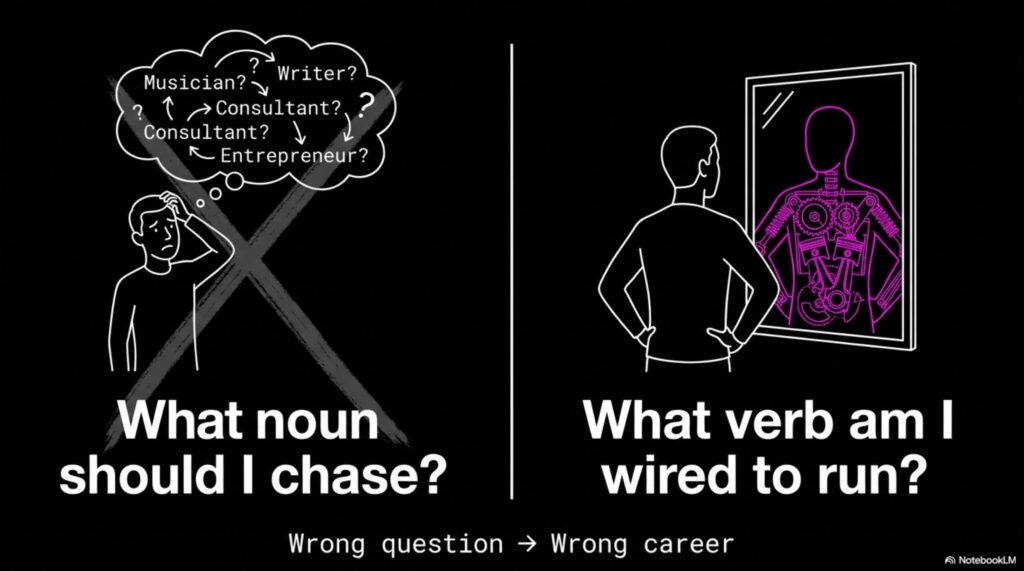
Verb vs Noun
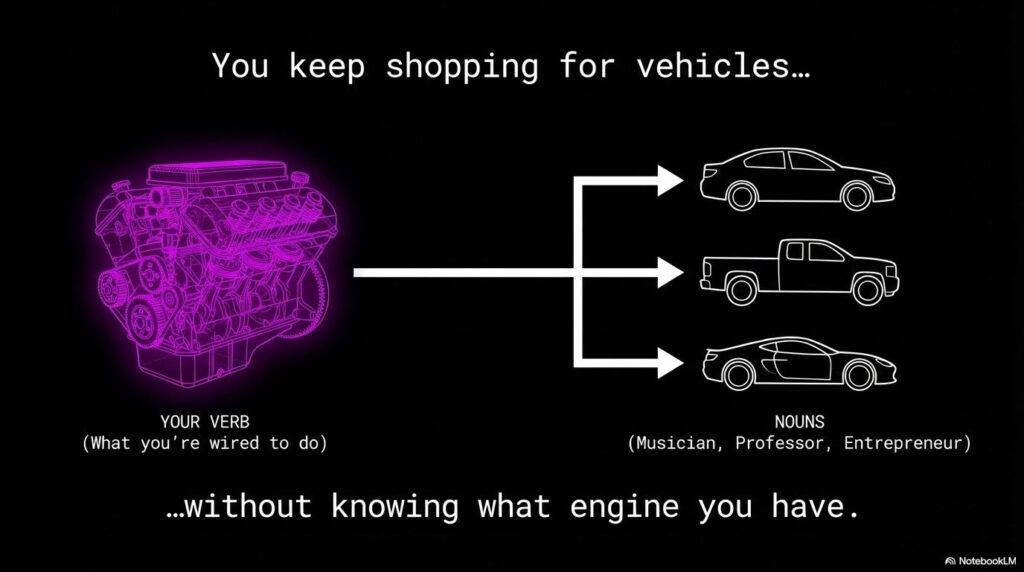
Your verb is what your innate engine does when it’s running right—the core activity that creates both your competencies and your satisfactions.
Your noun is the vehicle you put that engine inside. It’s what other people see and call you. It’s your job title.
Most people never identify their verb. They just chase nouns—entrepreneur, writer, lawyer—and wonder why none of them fit quite right.
Russ the guitar-playing professor isn’t stuck choosing between incompatible nouns. He just hasn’t identified his verb.
Look Under the Hood
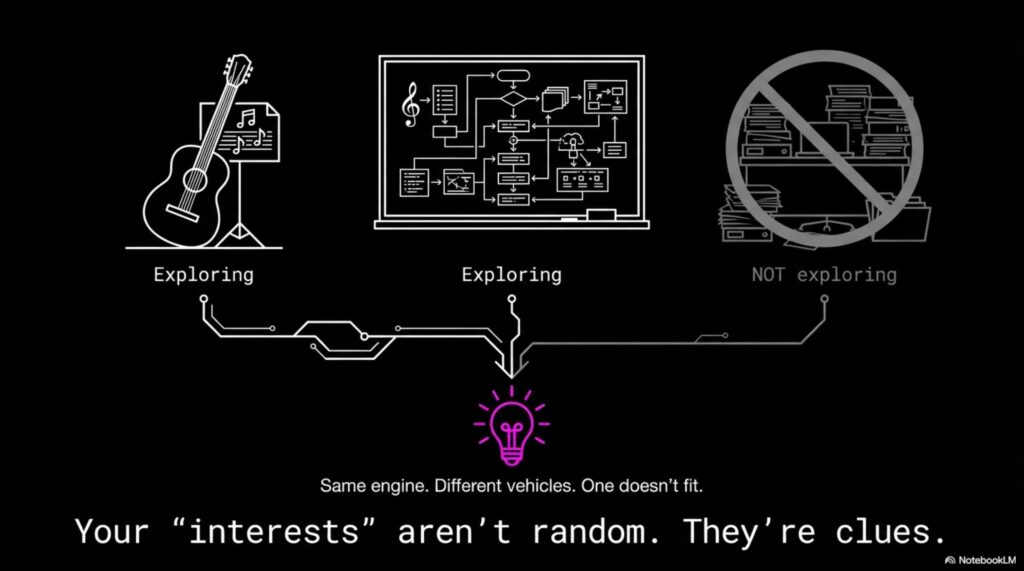
Let’s reverse-engineer the tiny bit of evidence we have on Russ’ engine:
Guitar: What if 40 years of enjoying guitar without attaining professional-level skill isn’t failure but a feature? He continues playing without caring about mastery because it’s a space to explore harmonic relationships, try new patterns, discover possibilities. The satisfaction—the source of fuel—is in the exploration itself.
Teaching? When it works, also architecting discovery spaces—designing how students encounter material, creating conditions for understanding to emerge.
Administration? Architecting bureaucratic compliance. Same design skills, soul-depleting application.
Russ’ verb: Architecting Discovery Spaces.
Russ’ fuel: Emergence and exploration.
Monetize the Verb
So how does Russ go from spewing dirty fumes in pursuit of pragmatism to pragmatic passion?
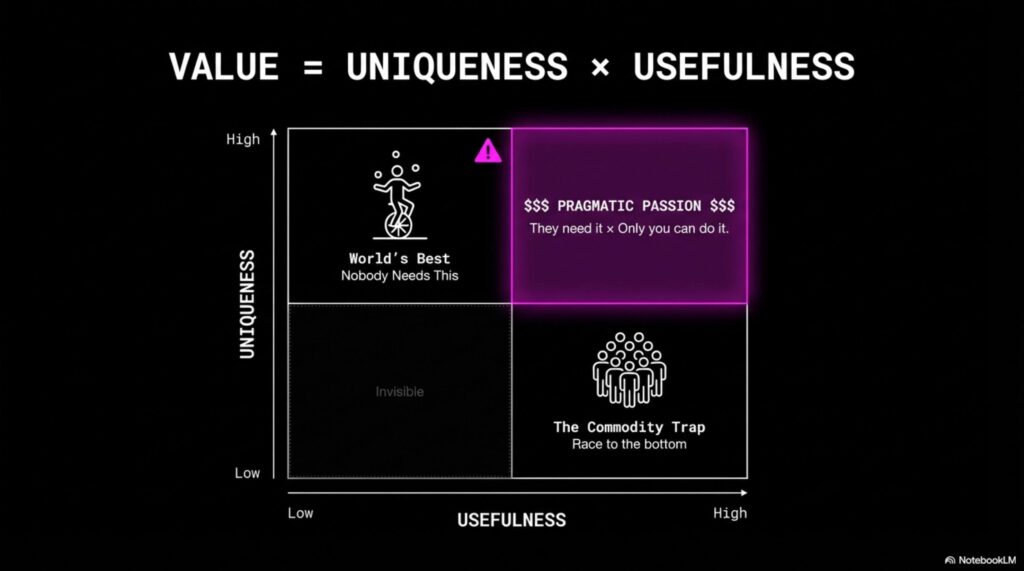
To monetize anything, you need two things multiplied together: Uniqueness and Usefulness. Being useful alone isn’t enough—water is useful but worthless when it’s everywhere. Being unique alone isn’t enough—you could be the world’s best at something nobody needs. You need both.
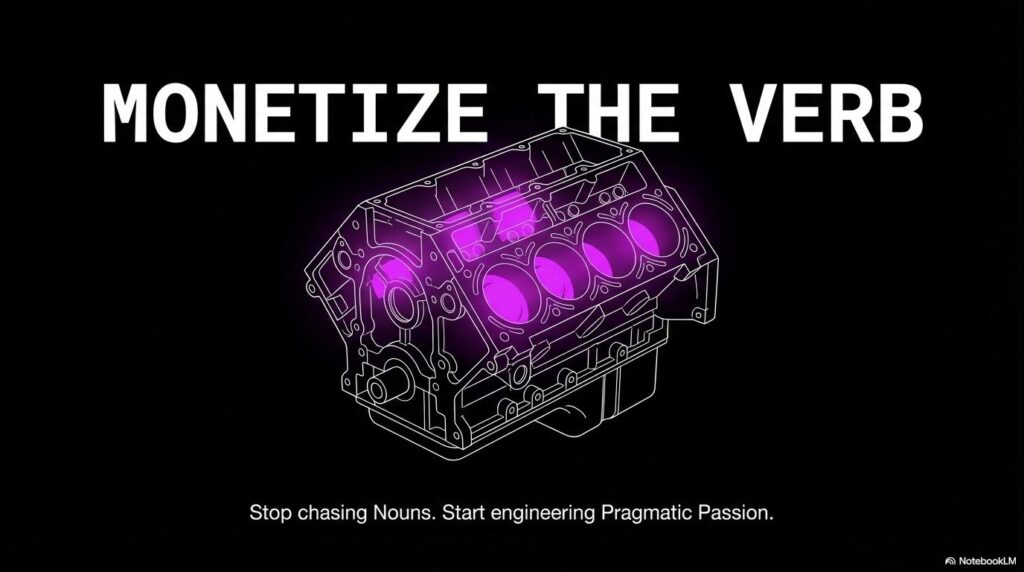
Monetize the verb.
Value = Uniqueness x Usefulness.
- For Uniqueness → find the verb that his engine is innately wired for.
- For Usefulness → put it in a noun that people need.
For Russ to monetize his verb, he’d ask: “Where does an engine that architects open-ended exploratory processes create unique value worth paying for?”
Maybe designing learning experiences for companies. Maybe creating exploratory tools for researchers. Maybe something that doesn’t exist yet because everyone’s too busy cramming themselves into conventional nouns and fuming through life.
But if we stop thinking in nouns and start understanding our verbs, we can design incredible, sustainable, and uniquely useful nouns.
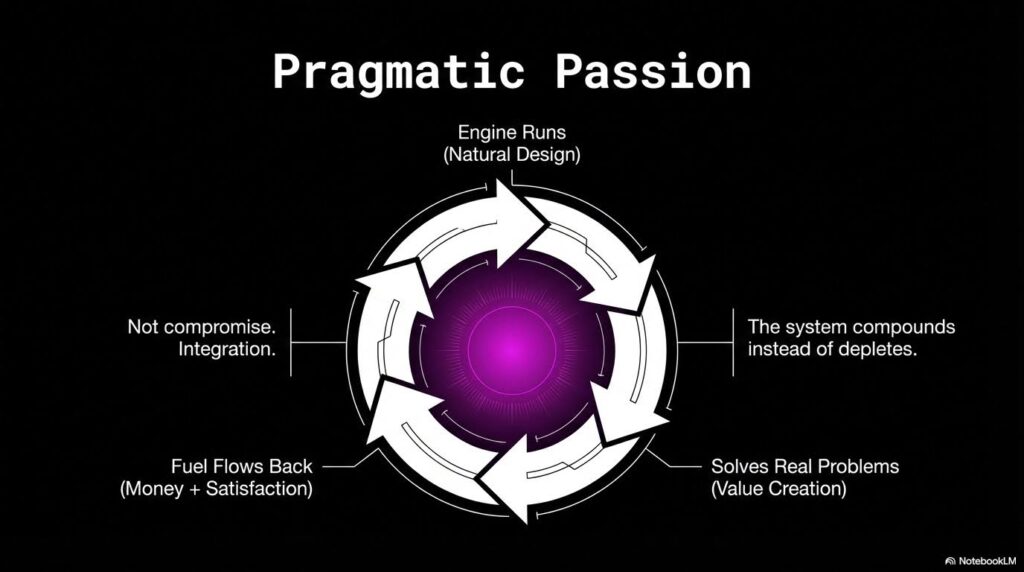
Pragmatic Passion: When It Works
When you monetize your verb:
- Your engine runs the verb it’s designed to run
- Your work connects to real problems people will pay to solve
- Solving those problems refills you with satisfaction and money
- The system gleams instead of grinds
Not balance. Integration.
Not compromise. Compounding.
My Bet
My verb? Reverse-engineering people’s operating systems and helping them position themselves into unique and useful nouns.
Building the Legant Method aligns with my wiring. My engine runs clean. But is it commercially viable, or just a passion project I can afford to pursue for now?
Based on the trickle of extrinsic fuel I’ve attracted, yes. But the trickle is steadily increasing in volume. I’m learning to run my engine more effectively and connect it to real contribution. And I’m still building the vehicle—my noun, Human Uniqueness Engineering. So I’m very optimistic.
So why share this “monetize the verb” framework before I’ve proven it myself?
If I call it now, people who see the logic don’t have to waste years churning in misalignment while waiting for me to prove it. You can start looking under your own hood now.
And in a couple years, this either compounds into a real business or it doesn’t. Either way, I’ve called my shot – so you’ll know if verb engineering actually works, not just whether I got lucky.
Your Turn
Start looking under your own hood. Quit looking around at others for nouns you’re qualified for or passionate about.
Reverse-engineer the verb your engine is actually built to run. Build around that for pragmatic passion. The world needs a lot more of it.
Thanks for reading.
Keep doing exciting things,
Chris
Society sands people smooth. I call it conformity waste.
The Zag is my running investigation into reversing it: decoding what makes you different and putting it to work. I publish what I find every 2 to 3 weeks. Zero spam.

About the author
I’m on an adventure developing better systems for understanding and designing around what makes each of us different. The Zag is where I share what I’m learning.
