

What could you accomplish if you aimed the move you keep making?
Everyone has a pattern to the way they operate. It makes them different. But almost no one names, hones, and harnesses their pattern. Instead, their pattern runs them, subconsciously.
Nick Gray is an unusually extreme example. I came across Nick in 2022. The bewildering variety of his endeavors intrigued me, his energy endeared me, and the lack of coherence puzzled me. He even once offered to buy my wife’s blog, FeedMyFriends.com.
What’s going on beneath the hood?
So I dug into Nick’s public profile – 30 years of personal blogs, dozens of projects, Tweets, podcast appearances, magazine profiles, and more – to decode the pattern underneath.
In 2024, the entrepreneur Andrew Wilkinson called Nick a “friend billionaire.” From throwing parties, organizing meetups, emceeing events, picking up Twitter friends from the Austin airport, and having a public phone number, lots of people know and like Nick.
Nick connects with people like billionaires make money.
In January 2024, at one in the morning, Nick posted a public call on Twitter. He was looking for a stranger to fly to Tokyo with him on an all-expenses paid blind date:
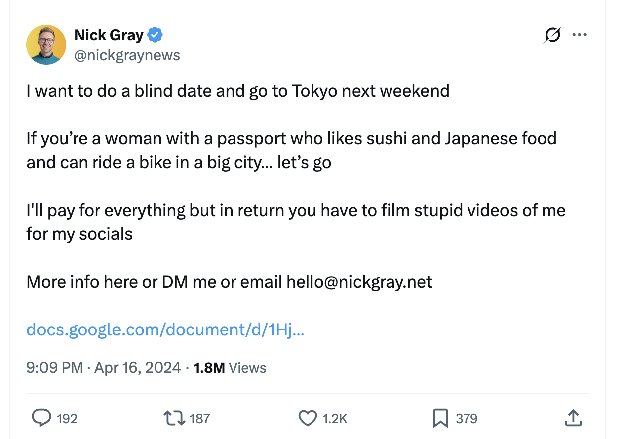
Four hundred women applied.
The first date happened, he live tweeted it, and it went viral.
No signs of a second date, though.
A few months later, on the My First Million podcast, the hosts asked Nick if he gets lonely.
“Probably,” he said. “I don’t exactly know what it would be not to be lonely, but I have a lot of friends.”
The kid who built ways in
Nick grew up an Air Force kid. His family moved between Arizona, California, Texas, and Georgia. He wasn’t part of the popular crowd and was really into computers.
By fourteen, he was making websites for local bands and small companies. By fifteen, he had a hosting business called vs3, priced at $14.95 a month, aimed at “the new web developer setting up a first website.”
He noticed a population blocked from the early web and built a way in for them. Early glimpses of the pattern that would later transform the geeky teenager into a friend billionaire.
At Wake Forest he joined a comedy troupe to learn how not to be shy. He also ran a software project out of his dorm called BuddyGopher, a pre-social media status feed.
After college, Nick came home to Georgia in 2005 to join his parents’ aviation-electronics business, taking on the job of introducing the company’s products to buyers who’d never otherwise have heard of the company.
Then in 2007 his family sent him to New York alone to handle East Coast sales. Arriving in the city knowing next to no one, he wrote, “It frustrated me that a city of millions could make me feel so lonely.”
So he started doing what he’s always done, creating his own ways in.
Becoming the friend billionaire
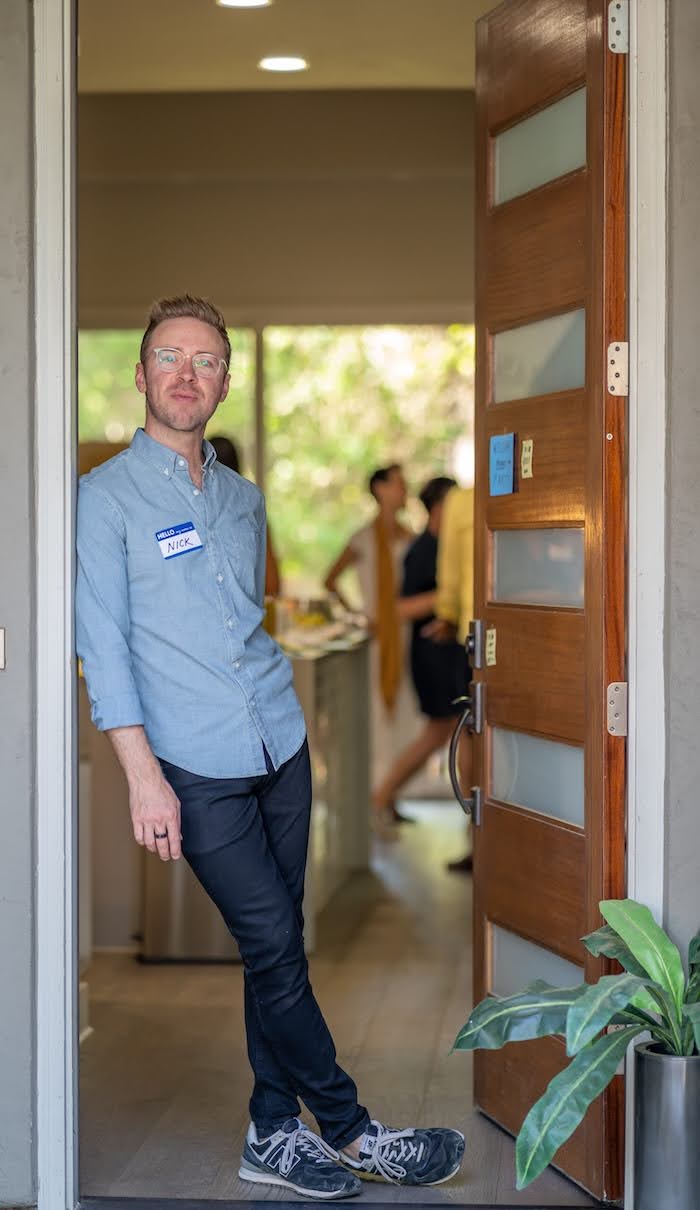
Nick approached strangers in McCarren Park, at Whole Foods, and at bowling alleys, handed them a business card with contact info, and added them to a monthly “Friends Newsletter.” He threw weeknight parties in his Williamsburg apartment with name tags and a typed itinerary sent out the day before.
By 2009 New York Magazine profiled the 27-year-old’s shindigs. The founder of Tumblr is quoted calling his parties “very culturally significant.”
Then a December 2010 date at The Metropolitan Museum of Art turned into 312 more visits over the next two years and eventually Museum Hack, tours led by stand-up comedians instead of art historians. Activities included scavenger hunts inside the museum. The company grossed over $2 million a year by 2019, when he sold it.
Nick moved to Austin, becoming a connector in the startup scene. In 2022, he published The 2-Hour Cocktail Party, a step-by-step playbook that turns hosting from an intimidating social art into a low-risk protocol including name tags, reminders, icebreakers, no plus-ones, and a strict two-hour window. My wife threw one in Cape Town. They’re great.
Then, Nick kept going with more projects:
- Mixily, an invitation platform he bought from a friend.
- PersonalWebsites.net, to help people put their best foot forward on the internet.
- Patron View, a database that pulls publicly available donor records into one searchable tool for fundraising professionals.
- Professional emceeing, to bring his unconventional connection tactics to conferences.
Nick’s monthly Friends Newsletter grew to over 20,000 subscribers.
He also registered FriendshipRecession.com in 2023, as a platform for research, statistics, and journalism on why adults are struggling to make and keep friends.
Then he posted that one a.m. call to Twitter, lonely and looking for a date in Tokyo.
The same move every time
The broad outline of Nick’s pattern is hard to miss. And it explains a lot: his “friend billionaire” status and financial success, but also his loneliness and restlessness.
The pattern’s there, but it’s never been named, honed, or aimed. So it has run wild. The results are impressive enough to catch my attention. They are also chaotic enough to make me wonder what’s going on.
Nick’s pattern is unusual, sure. But everyone has their own, too, running untamed in the background of their life, resisted and sanded down rather than sharpened.
Here’s my read of Nick’s pattern, five steps, over and over:
- He notices a system where the way in isn’t obvious.
- He finds the hidden friction, what’s blocking the first move people would otherwise take.
- He builds a simple starter formula that makes the first move easy.
- He animates it with proof, play, story, or specificity so people trust it enough to try.
- He documents it so others can run the formula, too.
I found this same five-step move in something like fifty of Nick’s projects. Once you see it, you can’t unsee it.
Many doors, no building
Let’s call Nick’s move “door opening”.
The cocktail party book opened the door to those scared to host. Museum Hack opened the door for one unforgettable tour of a “boring” museum. BuddyGopher opened the door to your friend’s information AOL concealed from you. Patron View opened the door between donors and fundraisers.
All door-opening formulas. Dozens of them across thirty years and many different domains, but following the same five steps.
Nick has spent thirty years opening one door, then the next, then the next.
The cocktail party ends at exactly two hours. The museum tours are of one museum, one time. The Tokyo blind date was one date. The Friends Newsletter is a one-way broadcast to introduce neat ideas to twenty thousand people.
This has opened up a breadth of connections that earned Nick the title of friend billionaire. But it also points at a lack of depth that leads to the loneliness Nick admitted in 2024, and multiple times prior.
What if he aimed at one target?
Nick made a breakthrough in 2025.
He met Lauren at Barton Springs Pool in Austin. He proposed to her at Big Sur a few months later. By the end of the year, they were married. Depth over breadth.
What if Nick made the same depth-over-breadth move with his pattern that he just made with Lauren?
Imagine all his door-opening energy aimed at one building: the fortress of friendship.
He could identify and open one barrier to friendship after another. Formulas for 1-on-1 time with someone you met at a 2-hour cocktail party, moving to a new city, running book clubs, you name it. Every door-opener would make friendship more accessible.
Nick could take a page from Atul Gawande. Gawande was a practicing surgeon who started writing about one problem he felt compelled to act against: medicine knows what good care looks like but keeps failing to deliver it. He published successful books about it and could have stopped there. Instead he built Ariadne Labs to take aim at that single problem by developing practical systems to solve it: checklists, conversation guides, and implementation programs.
Nick is already two-thirds of the way there. He’s a practitioner, with thirty years of hosting and connecting under his belt. And he has written about it — the cocktail party book, the blog, the newsletter, FriendshipRecession.com. What Nick hasn’t built yet is the lab, his version of Ariadne: one sustained effort that points all his door-opening at a single problem and keeps shipping new formulas into it.
The “friend billionaire” could do for friendship what Gawande did for care, and turn the friendship recession into a friendship boom.
There’s a coincidence that makes me think it’s meant to be. When Nick first walked up to Lauren at Barton Springs, she was reading a book. That book? Being Mortal, by Atul Gawande.
What’s your pattern?
All the above facts on Nick are true, but the interpretation is entirely mine. I’ve never met Nick and he never asked me to do this.
But I can’t help it. It’s my own pattern: I notice outliers whose surface explanations feel wrong, then dig in to figure out a structure that fits better.
We all run our own pattern that we can’t switch off. Left to its own devices, it runs us, just as Nick’s has opened a thousand scattered doors over thirty years. But if we name and aim our pattern, our effort and energy start compounding.
What might your pattern be, and what could it contribute if you finally aimed it?
Society sands people smooth. I call it conformity waste.
The Zag is my running investigation into reversing it: decoding what makes you different and putting it to work. I publish what I find every 2 to 3 weeks. Zero spam.

About the author
I’m on an adventure developing better systems for understanding and designing around what makes each of us different. The Zag is where I share what I’m learning.
