

Back in the early 2000s, Joe Liemandt outrecruited Bill Gates by promising top talent they would get to do something hard. No cushy coding. Work so hard nobody was sure it was possible. So challenging that his company, Trilogy, and the Navy SEALs swapped bootcamps.
Twenty years later, Liemandt has shifted his recruiting target: kids. He wants to enroll a billion of them in his Alpha Schools. He hasn’t changed his strategy, though. Kids, like Navy SEALs and elite programmers, want to do something significant to test what they’re capable of.1
To each their own challenge
Who doesn’t want their own significant challenge?
Sure, it’s nice to read a book on the beach, order pizza, and take a rest day. But those aren’t things you’ll ever feel particularly proud of. I ask all of my clients what their proudest accomplishments are. “Making it through all seven Game of Thrones seasons and two stuffed-crust pizzas in one sitting” has never been an answer. The answer is always something hard and significant.
The most common hard and significant challenge people choose to take on and are proud of is raising kids. On a day-to-day basis, being a parent is unequivocally harder than the alternative: more responsibility, more stress, less money, less freedom. But millions of people choose it and relish the challenge every year2. The ultimate marathon. (Running a marathon is another popular, though less significant, challenge.)
For some, raising kids is the challenge of a lifetime. It consumes them and they’re glad for it, filling their lives and homes with memories they wouldn’t have exchanged for anything else.
For others, including me, raising kids is certainly a challenge, but it’s a subset of another significant challenge.
To each their own challenge. The important part is finding it.
What good is an easy life?
Jerzy Gregorek’s saying comes to mind:
“Hard choices, easy life. Easy choices, hard life.”
It used to resonate. Back in 2023 I included it in my 15th-ranked rule to live by. But now I think the saying is missing a beat.
I agree with “easy choices, hard life.” Easy choices lead to a hard time paying bills, getting along with people, and walking up a long flight of stairs. Those are challenges you don’t want and won’t feel proud of. They don’t test what you’re made of or tell a good story.
“Hard choices, easy life” is the part I’m not on board with anymore.
What’s an “easy life”? Collecting a big paycheck to do nothing difficult? Early retirement? An easy life only sounds appealing relative to hard unrewarding work.
But an easy life doesn’t appeal to Navy SEALs, Trilogy talent, or Alpha students. Or me. We’d rather make hard choices in pursuit of a hard life.
Hard choices, hard life.
Not a masochistic, oof-I’m-glad-that’s-over hard life. That’s just an easy choice wearing a hard hat. I mean choosing challenges that test me and contribute something useful. Choosing uncertainty and the risk of failure because it makes for a better story.
The type of hard life I want is a quest.
The decision you’d never trade away
Raising a kid becomes a quest the second its umbilical cord is cut.
Joe Liemandt’s Alpha School mission is a quest, too. He is staking his time, energy, reputation and a billion plus of his dollars to reinvent childhood education.
“[T]he best decision ever,” he calls his hard choice. “My job today is so much better than my Trilogy job, not even close.”
Two others who come to mind are Demis Hassabis and Bryan Stevenson.
Hassabis’s quest is to create true general artificial intelligence for the good of humanity. He was a child chess prodigy, but quit to look for a game that mattered. At 17, he turned down an offer of one million pounds to work for a video game company. Demis keeps making hard choices in pursuit of his quest.
Bryan Stevenson’s quest is justice for people crushed by the legal system. A Harvard educated lawyer, his hard work opened up lots of more lucrative, luxurious paths. But he made the hard choice to have a hard life.
Both of these men have books and movies about them, The Infinity Machine for Hassabis. Just Mercy for Stevenson3. They are celebrated for their commitment to their hard, significant challenges—their quests. If you offered them to go back and make the hard choice for an easier life – more money, less uncertainty – they wouldn’t even blink.
The right hard choice is hard now and easy in hindsight.
But what about the Hassabises and Stevensons who we’ll never watch movies or read books about because their quests failed? Uncertainty is the price of admission, so there have to be failures. That’s the bucket I fall in so far.
Luck is part of the equation. Like with any business venture, for any chance of success you need to be in the right place, at the right time, with the right abilities and the right people to support you.
But I’m betting it’s possible to increase your chances.
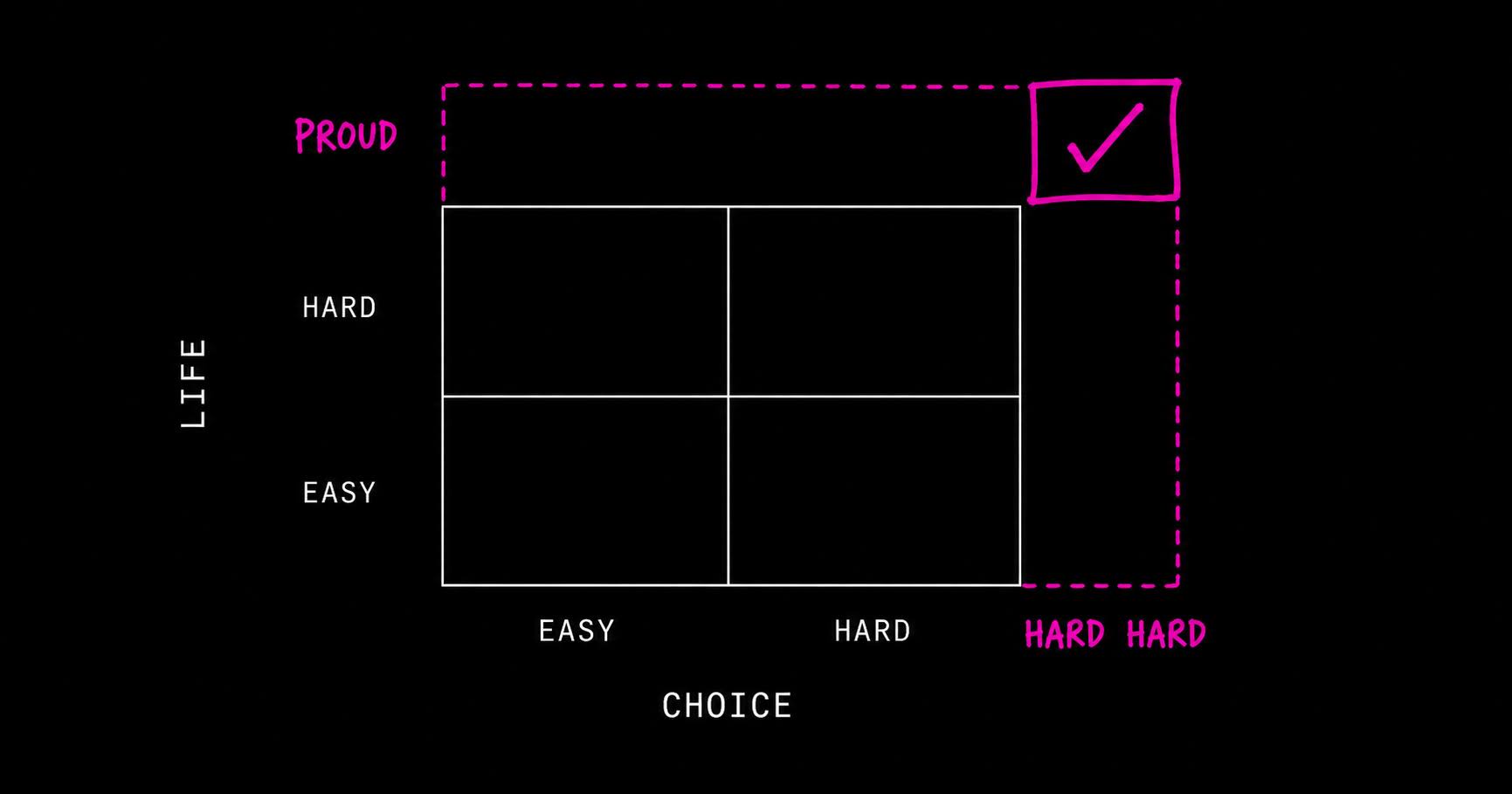
The hard hard choice
A surefire way to fail is to make the “hard” choice of taking on a quest because it’s popular or impressive. Trying to follow Hassabis’s lead and build an AI startup, for example. Or opening a restaurant. Those are easy hard choices that lead to an unrewarding hard life, for you and for others.
The hard choice that’s more likely to be the right choice is the hard hard choice, a quest that:
- most people disagree with or find uninteresting,
- you believe in on first principles, and
- others couldn’t pull off even if they tried.
The quest question:
What can you build that uses what makes you different to make a difference?
If you’re unusually willing to sacrifice autonomy, interested in childhood development, and fueled by benevolence, raising a pack of kids could be the quest you’re made for.
Parenting doesn’t tick all my boxes, so I need another quest to supplement raising my sons. My hard hard choice:
To decode human uniqueness. That means building an ever-improving framework for unraveling what makes a person different and putting it to work to make a difference.
The people I most want to benefit from my work are my two sons, but I aim to make a much more systematic difference. Too many people’s spiky potential is sanded down rather than sharpened. My quest is to reverse that.
It’s a recruiting challenge, really.
Just like Joe Liemandt won talent from Bill Gates, I need to attract talent away from conventional paths.
Who’s interested in testing what they’re made of by building something only they could build, and that matters enough to be worth the effort?
High uncertainty, major chance of failure, and guaranteed hard work.
That’s my recruiting pitch to you. It requires a hard hard choice. But I believe it easily beats the easy life.
Listen to Liemandt on the My First Million podcast for more on this. ↩
Which makes me wonder… is raising two kids hard enough, or am I taking the easy way out? ↩
Stevenson also appears in The Sun Does Shine, which is how I found out about him. ↩
Society sands people smooth. I call it conformity waste.
The Zag is my running investigation into reversing it: decoding what makes you different and putting it to work. I publish what I find every 2 to 3 weeks. Zero spam.

About the author
I’m on an adventure developing better systems for understanding and designing around what makes each of us different. The Zag is where I share what I’m learning.
