

The point of self-help is that the more you consume, the less you should need. But the opposite tends to happen. You just keep gobbling — more assessments, more frameworks, more optimization. More and more, but the only exciting places it takes you are James Clear book signings and Andrew Huberman live podcast recordings.
But I think I found an escape hatch from the self-help vortex. I call it self-use.1
Self-help asks: Who am I? What are my strengths? How do I optimize myself?
Self-use asks: What’s my fight? How do I use what I’ve got to fight this?
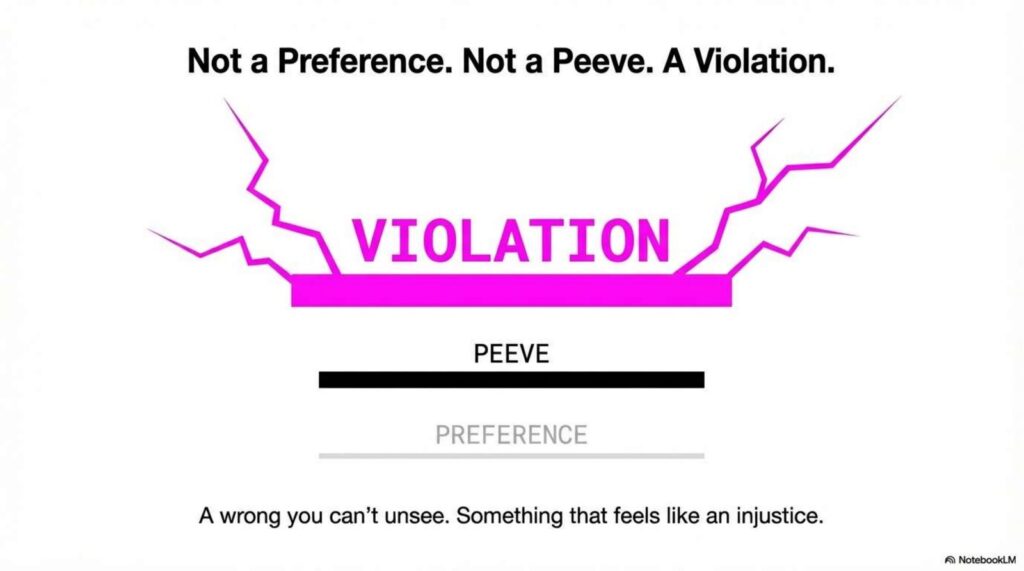
What pulls you out is finding your violation — a wrong you can’t unsee, something that bothers you at a moral level. Not about you — outside of you. Find it, and the seeking stops. The building starts.
A Moral Flinch
I listened to a podcast recently where the man I’d most want to have lunch with2, Patrick O’Shaughnessy, was being interviewed by podcaster David Senra. Patrick is usually the one asking the questions — he hosts Invest Like the Best — so I was extra excited to hear him on the other side.
Patrick talked about spending most of his 20s searching. Thousands of books. Philosophy, religious texts, psychology, personality tests. Deep in the self-help vortex, trying to understand himself.
Then, around 2012, he found a video by a computer scientist named Bret Victor called “Inventing on Principle.” Victor makes the case that everyone has — or can find — a guiding principle: something that when you see it violated, you feel compelled to go correct it.
Victor spent about a decade searching before finding his.
Victor’s violation:
Ideas dying because creators lack immediate connection to what they’re creating.
In his words: “It hurts. It feels like a tragedy. To me, it feels like a moral wrong. It feels like an injustice.” That’s not a preference. Not even a peeve. It’s a violation. He’s built his entire career around closing that gap. Different tools, different mediums, different companies — one fight.
Victor closes with a challenge:
“You can choose to sleepwalk through your life and accept the path that’s been laid out for you. You can choose to accept the world as it is. But you don’t have to. If there is something in the world you feel is a wrong, and you have a vision for what a better world could be, you can find your guiding principle. And you can fight for a cause.”
Obsession, Relocated
Patrick heard that challenge and chose door B. He stopped looking inward and started looking for a cause to fight for. What he found:
Extraordinary potential going unnoticed. Talent that goes undiscovered.
Once he named his violation, his obsession didn’t end. It relocated. From “Who am I?” to “Where is the overlooked potential, and how do I be useful?”
A goal would have pointed him in one direction. His violation pointed him in all of them. Every new person, project, and conversation became a signal: is there overlooked potential here? Can I act on it? It’s taken him in extraordinary directions — investment fund Positive Sum, his podcast Invest Like the Best, and now his media company Colossus — each vehicle different, all fighting the same fight. He tells Senra he no longer finds introspection interesting at all: “I have very little introspection left in my life.”
Self-help became self-use.
My Problem Had a Problem
Same thing happened to me.
Patrick shared Victor’s talk with me back in 2021. I was deep in my own vortex — seeking, writing about, testing every personality framework from CliftonStrengths to “What kind of cat are you?” I’d realized I needed what I was calling a “problem,” so I thought I had it covered. But when I rewatched the talk in 2026 after hearing Patrick discuss it with Senra, I realized I’d been missing a distinction. A problem is something you solve for a client. A violation is something you can’t stop fighting. More visceral.
So I sharpened my problem into a violation — what actually makes me want to fight:
Spikiness being smoothed down by the forces of conformity. Unique wiring — in people, ideas, businesses — getting flattened, overlooked, or left unused because the system is designed to flatten it, not to sharpen it.
I’ve been fighting this violation since I started building ARC this past year. It ozempic’d my appetite for self-help. Even my reading flipped. Personal development books do nothing for me anymore. Instead, I read stories about spikiness fighting conformity. That’s self-use.
Everyone Has One
Patrick, Victor, and I got to our violations through years of unstructured seeking. Part of my self-use is helping others find theirs faster.
What’s surprised me across the 15+ people I’ve done this with: when you collect data from different lenses — someone’s stories, their psychometrics, what they’re most proud of, what bothers them, their values, their pet peeves — a common violation stands out like the unifying theme of a book of short stories.
Some examples:
Inherited expectations channeling potential into battles it was never designed to fight.
Carelessness and mediocrity degrading the spaces, experiences, and things I have to live with.
Brave risk-takers punished by systems designed for the status quo.
Inertia keeping systems stuck even when the stagnation is killing them.
People falling through the cracks because of disorganized execution on good intentions.
Industrial conditioning treating humans like machine parts rather than ecosystems.
Different people. Different fights. Same pattern.
Self-Help Vortex → Self-Use Flywheel
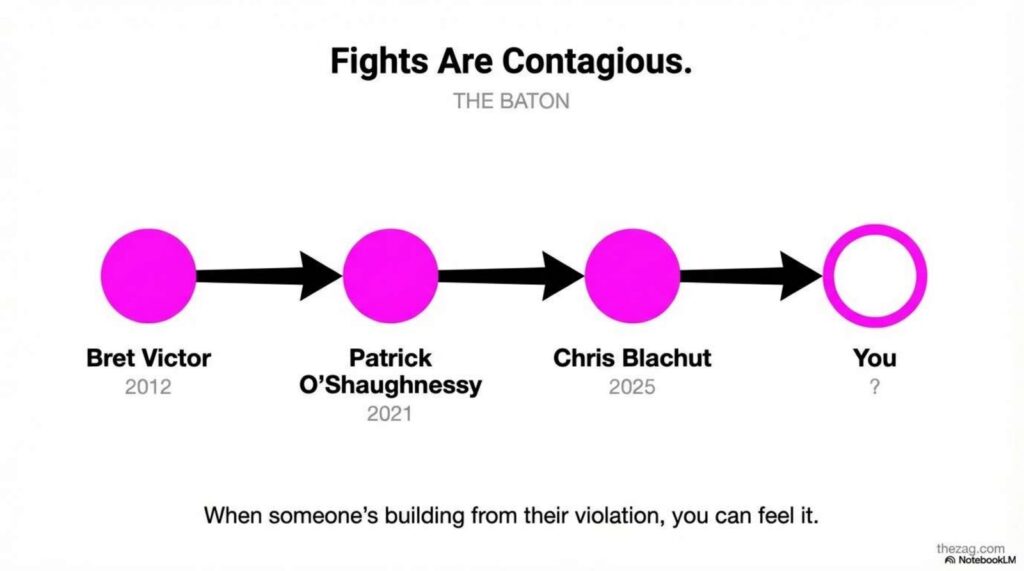
Victor found his violation. He shared it in a talk. Patrick watched that talk, found his own, and built a career around it. Patrick shared it with me, and I found mine. Now I’m helping others find theirs.
Fights are contagious. When someone’s building from their violation, you can feel it. And it makes you want to find yours.
Keep doing exciting things,
Chris
1 I’m aware this idea has a name: Transcendence. Scott Barry Kaufman’s book of the same title is excellent — I wrote about it back in 2020, when I still had no idea how to escape the vortex myself. ↩
2 Who’s yours? My wife asked me this a couple of years ago, before I’d found my violation. I had no idea. I think having an answer is a good sign you know what you’re after — and what you’re fighting for. ↩
Society sands people smooth. I call it conformity waste.
The Zag is my running investigation into reversing it: decoding what makes you different and putting it to work. I publish what I find every 2 to 3 weeks. Zero spam.

About the author
I’m on an adventure developing better systems for understanding and designing around what makes each of us different. The Zag is where I share what I’m learning.
