

CliftonStrengths, DiSC, and Myers-Briggs are built built for a world of paper forms and scantrons. To scale, they had to cram everyone into standard boxes. That constraint is gone.
So when a client asked me to build something better for his team, I said yes. Here’s what happened.

“Can you outdo our DISC session from last year?”
That was Evan’s challenge.
Evan had subjected himself to my full ARC process earlier this year—weeks of discussion and deep dives mapping his wiring. He found it valuable enough to stick his neck out and suggest I do a speed-run version for his seven-person data team.
But the full ARC process takes hours of 1-on-1 time. Could I create something meaningful that required only 60 minutes of pre-work per person?
Not sure. But I’d been preparing for this problem for over two years.
Challenge accepted.
The Ostrich Feather Problem
Back in September 2023, a coach named Peter Holgate had me take the CliftonStrengths assessment. I was super impressed… by the business model.
The results didn’t provide much insight. “Learner,” “Strategic,” “Analytical.” Oh really, my top strength isn’t Fashion Design? Sure, the validation and articulation help a bit. But as I clicked away from the boilerplate results to explore Gallup’s site, I was surprised by the strength of the business. Courses, consulting, certifications—and that’s just the offers starting with the letter C. All built on classifying people into 34 standardized boxes.
Myers-Briggs, DISC, Kolbe Index, and dozens of others do the same.
It bugged me.
Sure, each assessment captures something real, but only one fragment at a time. Understanding only parts of yourself is like a biologist studying ostriches by examining their legs separately, then their feathers, then their eggs—and never actually seeing the complete bird, let alone figuring out what it’s good for.
For fifty years, this fragmentation was the best we could do.
But not anymore. (At least I’m betting years of my productive life on it.)
Being bugged by this has metastasized into a problem I’m obsessed with solving. I’m trying to become the world’s leading “Human Uniqueness Engineer.” That means helping you figure out what you could be the world’s best at if you harnessed your inner ostrich (or other species).
I’ve run a baker’s dozen of guinea pigs through the full ARC process. So far no fatalities. Each got prescription lenses on their previous blurry understanding of their wiring. But that clarity compounds over years, not months. I can’t wait years to prove this works.
I need experiments with faster feedback loops. Edge cases that break my assumptions. Failures that forge better frameworks.
Evan’s team session was a perfect test.
Three Ingredients, Infinite Combinations
I stripped the full ARC mapping methodology down to three high-signal data sources:
1. Personality Assessment (Big Five Aspect Scale)
Not Myers-Briggs. Not DISC. The Big Five is the most scientifically robust personality model we have—decades of peer-reviewed research, publicly available data.
2. Values Assessment (Schwartz PVQ-RR)
This measures 19 core human values arranged in a circular model where opposites compete. E.g., high self-direction requires low conformity. These built-in trade-offs reveal what actually drives you, not what you think sounds nice to interviewers and first dates.
3. Peer Perception Exercise
Each team member provided anonymous feedback on everyone else, answering one question: “If you were CEO of Humanity, what single role would you give this person to help them thrive and contribute their best? Why?”
Total time investment per person: 40-60 minutes. (Less if your feedback for all your colleagues is “Human Paperweight” or “Assistant Paint Drying Overseer.”)
Then comes the fun part. I can synthesize personality + values + peer perception through AI pattern-matching that wasn’t possible five years ago.
The process: I feed the raw data through frameworks I’ve spent years developing (83-page methodology), run multiple quality control passes, then edit for accuracy and tone. The result is personalized analysis at a depth that would previously require a team of psychologists—generated in hours, not weeks.
This is the breakthrough CliftonStrengths can’t replicate. Their 1998 technology required standardization to scale. Mine doesn’t. The constraint that forced everyone into 34 boxes is gone.
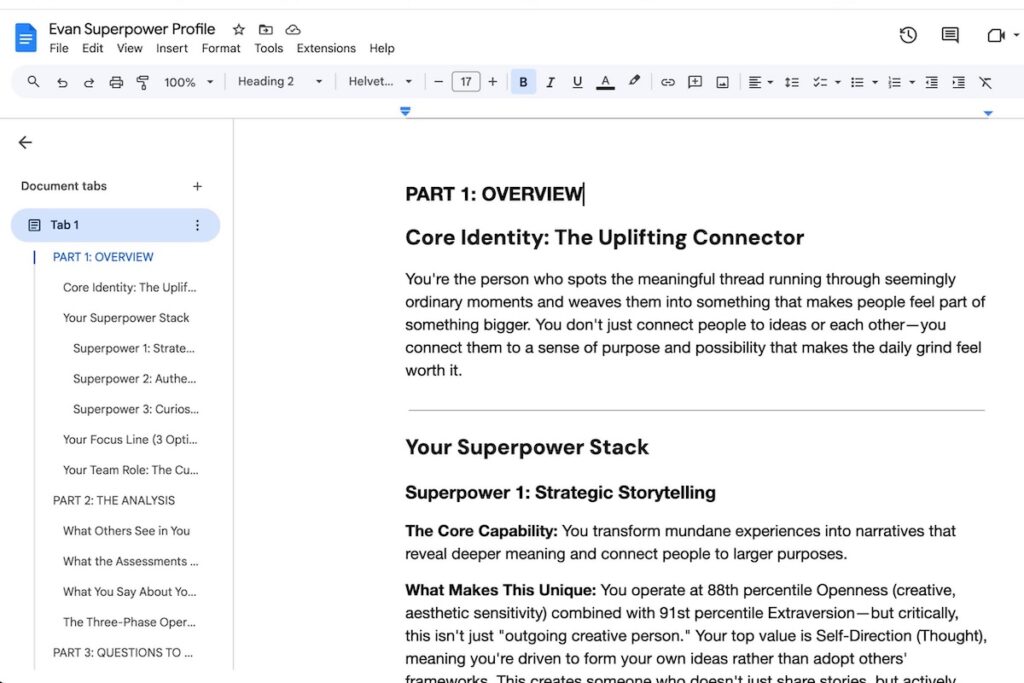
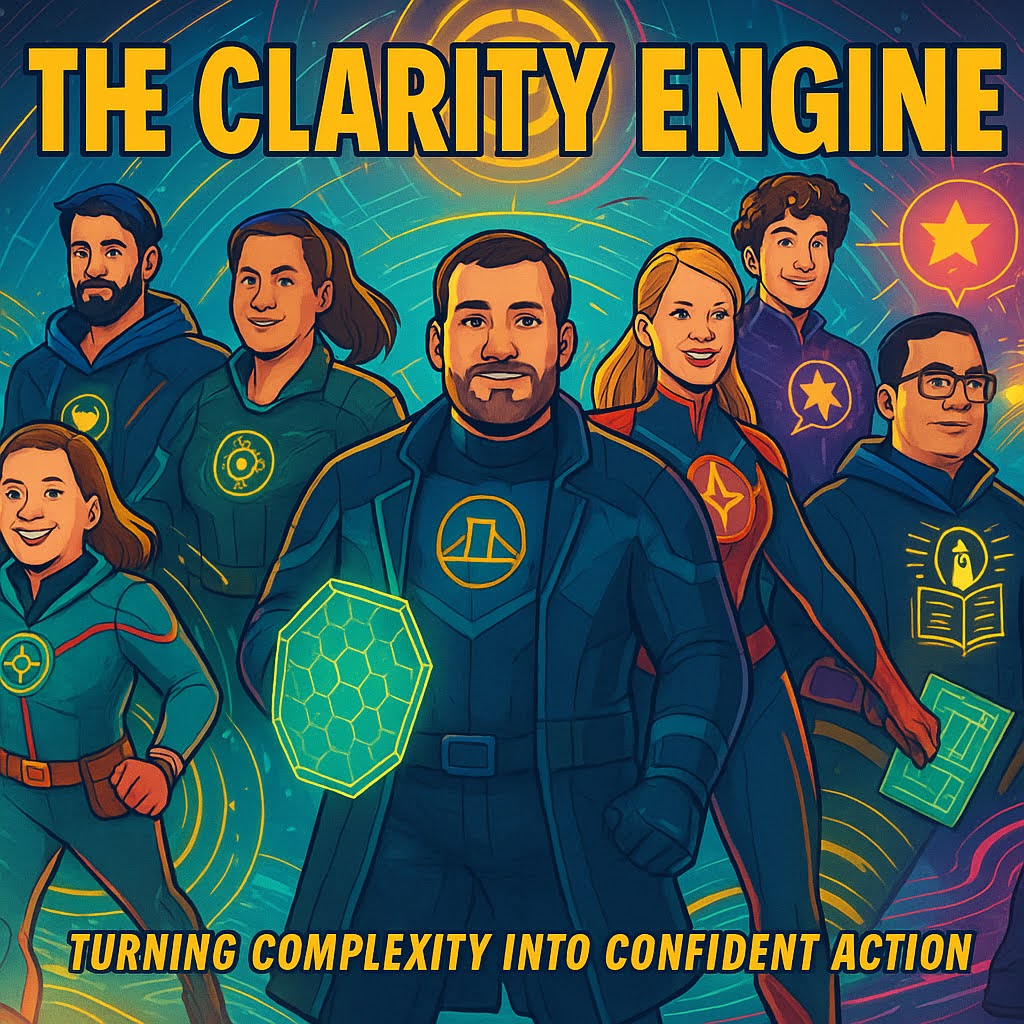
Most exciting and experimental of all: I consolidated all seven individual reports into a team analysis that answers questions like “How could these people assemble like the Avengers?” and “What blind spots does this team share?” See the anonymized team report.
The ENTJ Becomes The Guardian of Wonder
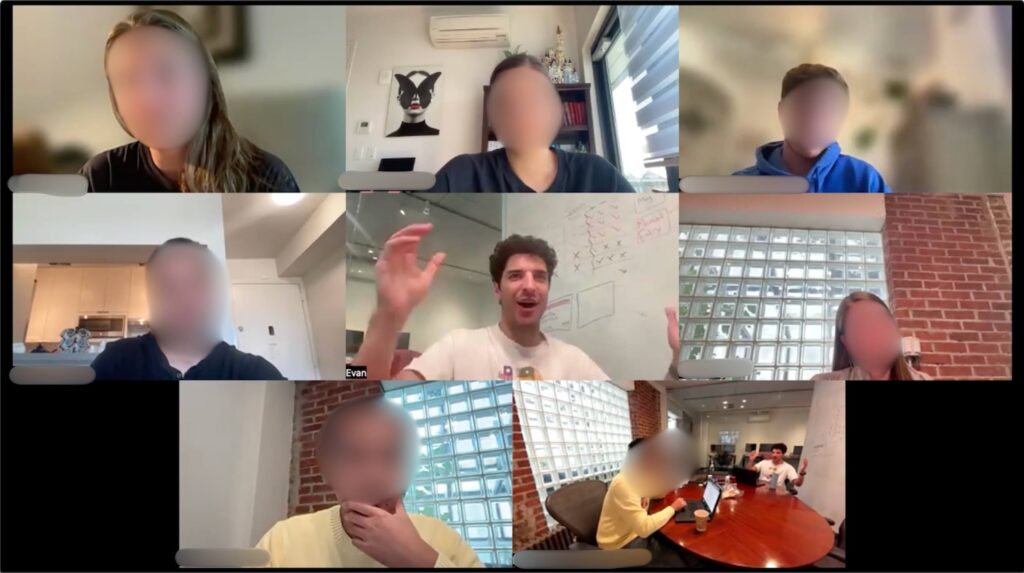
Evan facilitated the session with his team. (In retrospect, I wish I’d been in the room. As ably as Evan handled it, I would have loved to be able to explain the methodology myself and push them harder toward action.)
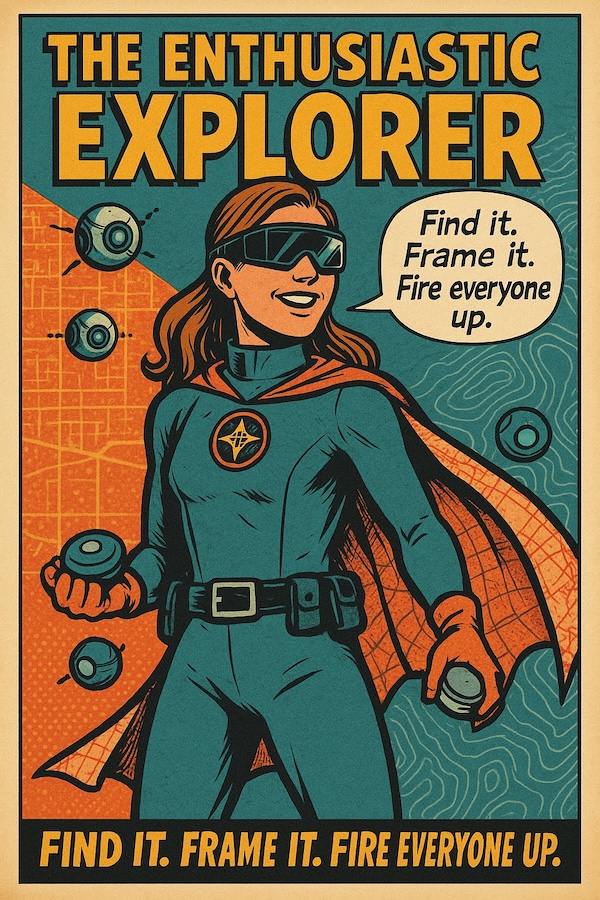
Each person got a unique identity instead of a generic label:
- “The Strategic Stabilizer”
- “The Enthusiastic Explorer”
- “The Relentless Strategist”
- “The Precision Catalyst”
- “The Uplifting Connector” (Evan)
One teammate called Evan “The Guardian of Wonder,” someone who “helps humanity not get jaded and continue to get inspired, even by the banal.”
That’s a step up from “you’re an ENTJ” in my books.
Rather than label people, these reports revealed patterns that teammates recognized and could name with specific examples.
Discussing his own report, Evan connected the implications of his low Orderliness to a project he was passionate about: “Behind the scenes… there’s like three or four layers of Notion docs that are not very orderly. It has required a lot of effort.” This gave the team a deeper understanding of his operational style, and where they might be able to support him with their complementary profile.
The team analysis uncovered something even more interesting: The entire team scored low on “Power-seeking” values. Power Resources (control of material/social resources) averaged 14th percentile. Power Dominance (exercising control over people) was even lower.
Translation: Fantastic internal cohesion. Nobody’s playing political games or jockeying for status.
Trade-off: Lack of organizational self-promotion may leave their team under-resourced and under-appreciated.
The team nodded in agreement as Evan recognized it: “As the company gets bigger, political influence does matter if we want our projects prioritized. We need to do our best to tell the story of why our work matters.”
This is what you see when you study the whole flock, not just classify individual beaks.
Overall: No audible “oohs” and “ahhs,” but minimal yawns and a discussion that dug below surface-level truisms.
Evan rated it 8.5-9 out of 10. Yes, he’s a biased, inveterate rose-lens-framer. Still, a decent first experiment. But not a 9.5 or 10. Definitely not.
The Parts I Botched
The team spent nearly the entire hour taking turns summarizing their individual profiles like middle schoolers doing book reports after skimming during recess.
Not due to disinterest—Evan sent me screenshots of animated Slack discussion after I’d sent the reports out the day before. But because I didn’t give guidance.
One teammate said it outright: “For something like this, gimme a task to speak about it for five minutes, I would wanna prepare a lot because I take the stage seriously. I want the five minutes to be good. And I did not prepare for it and I don’t feel good about that.”
Not their fault. Mine.
And since they were unprepared and inefficient with presenting themselves, they barely touched the team analysis, which contained especially strategically valuable insights.
Worse still, “So what?” never came up. People felt seen, but did it change how they work together? Not explicitly. No different from CliftonStrengths or DISC. But I have higher aspirations than pseudo-psychological entertainment.
Next time I’ll provide clear structure for the meeting and lead it myself to push the pace and drive toward concrete action over fluffy introspection.
Well…I hope there will be a next time.
What This Might Mean (Tentatively)
One experiment doesn’t prove anything, but it suggests promise:
- The efficiency breakthrough appears real. 60 minutes of input → 8.5/10 accuracy rating from someone who’d been through the full intensive process and could compare.
- Wholeness generates different insights than fragments. Synthesizing personality + values + peer perception revealed patterns that isolated assessments can’t pick up.
- The technology constraint is genuinely gone. CliftonStrengths launched in 1998. Myers-Briggs dates to the 1940s. They had to standardize to scale. We don’t anymore. Personalization at scale is now in our pockets.
- But credibility remains my biggest gap. Why should anyone trust my methodology over tools with decades of track record? How do I build that track record if nobody trusts me enough to try? Classic chicken-and-egg.
Which brings me to why I’m writing this post.
The Real Experiment is This Post
I want you to see what I’m working on, not just the polished discoveries I eventually arrive at.
So here’s the ask: Don’t just spectate. Participate.
For Individuals:
I’m offering the same “Superhero Profile” I created for Evan and his teammates.
- What you do: 40-60 minutes total (two assessments + peer feedback).
- What you pay: $59.99 (matching CliftonStrengths’ price as a value test).
- What you get: Your unique “inner species” identity, superpower stack, kryptonite, one-sentence Focus Line for decision-making, plus your Boundary Line.
Here’s Evan’s full report to show you what to expect. 3,500 words plus appendix. This isn’t a lightweight, colorful template. It’s a deep dive. If you rather a tidy little acronym, color, shape, or star sign, this isn’t for you.
Limited to 10 people
For Teams:
I’m looking for 2-3 teams (5-10 people ideally) to partner with (ahem, experiment on) as I refine this process.
Email me “ARC for Teams” at c@thezag.com.
That’s it. We’ll take it from there. I promise price won’t be an issue. Your feedback’s worth more to me than your money.
Questions For You That Would Actually Help Me
If you’ve made it this far, take the last step:
- Does this feel more valuable than getting “INTJ” or “Strategic”? Why or why not?
- What would make you hesitate to try this? (Imagine your best friend asked you, “Why won’t you take Chris up on his offer?” What would you say?)
- What would need to be true for you to recommend this to others?
Hit reply. Leave a comment. Message me on LinkedIn for chrissakes. Take action.
Thanks for tagging along on this experiment. Here’s to you finding your own obsession to experiment on, too.
Keep doing exciting things,
Chris
Society sands people smooth. I call it conformity waste.
The Zag is my running investigation into reversing it: decoding what makes you different and putting it to work. I publish what I find every 2 to 3 weeks. Zero spam.

About the author
I’m on an adventure developing better systems for understanding and designing around what makes each of us different. The Zag is where I share what I’m learning.
