

“What would my 95-year-old self think?” isn’t meant to be just a thought experiment.
Your 95-year-old self wouldn’t exactly be ecstatic to see you “thought-experimenting” or “journaling” or “meditating” about them. “Oh great, pretending to care about me, again. Like my child popping by the retirement home while scrolling their phone the whole time.”
The frame I use: my 95-year-old self is the Chairman. He sees the big picture of my life, while I’m just a lowly VP reporting an update from operations. I can’t BS him, because he’s way wiser than me. And I desperately want to impress him. No, I NEED to impress him.
So I went beyond thinking about what my 95-year-old self would want to know. I wrote him a report. What I built, what failed, what that means.
Already write annual reports for your business? Those don’t count. Shareholder priorities and 95-year-old-self priorities don’t fully overlap. You decide whose priorities are more important.
Here’s mine. Year 1 of ARC—my methodology for helping people stop wasting potential on conforming paths and start compounding advantage by building around their spikiness.
The external numbers look rough: $5,456 revenue, 410 lost subscribers. But compressing the year into one page forced clarity I didn’t have before—like that four of my five failures shared the same root: inability to externally communicate what ARC produces. The methodology evolved. So did my understanding of my own wiring. My ability to translate it outward lagged behind.
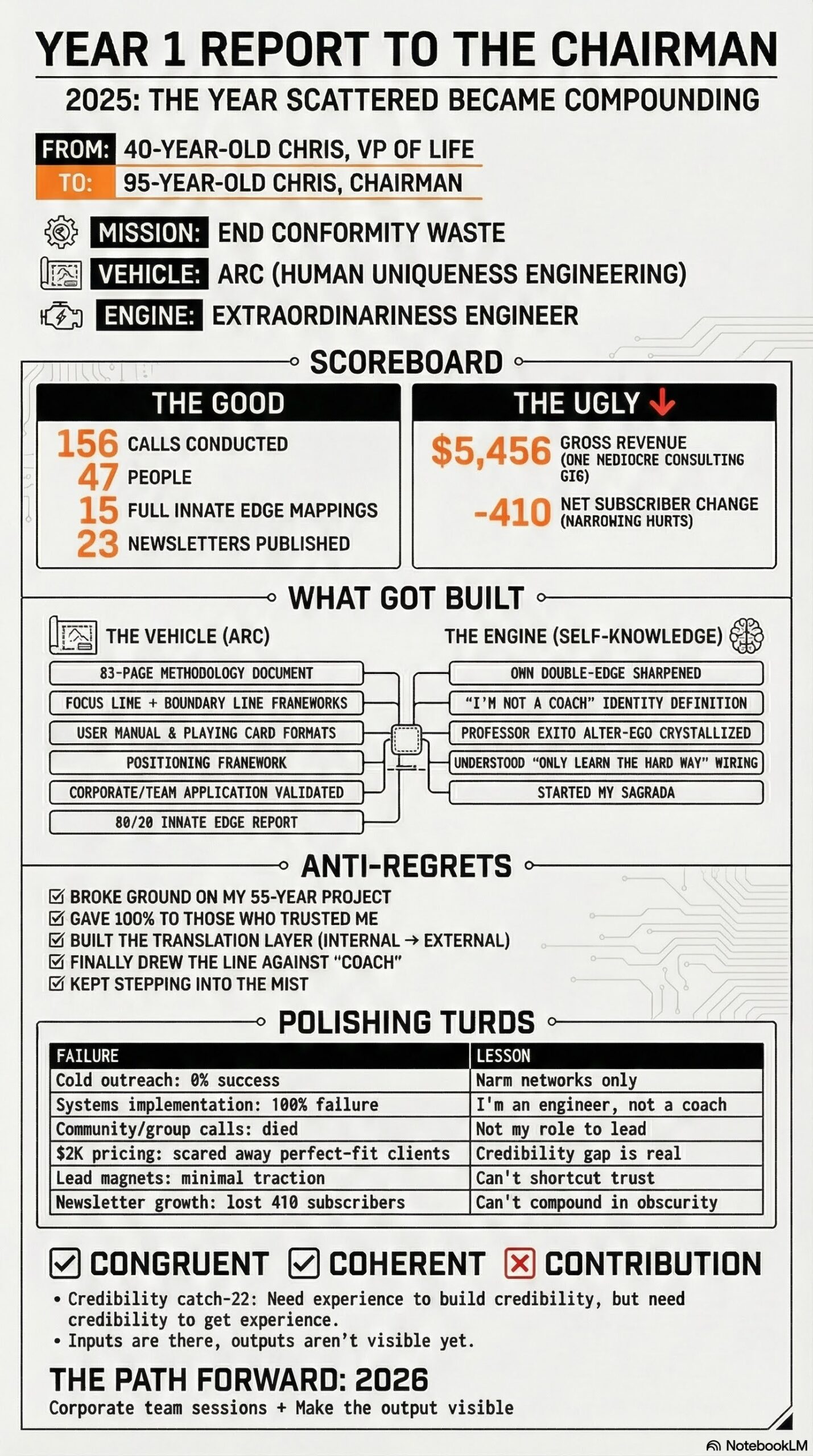
I invite you to read this as a board observer. Chime in with advice, criticism, or input.
And consider: What would YOUR report to your Chairman say? Not the LinkedIn version—the one you’d be nervous to show a friend acting as a proxy for your 95-year-old self.
Speaking of which, if you actually make one, I’d like to see it. If you don’t, I’d like to hear what your 95-year-old self thinks.
Thanks for reading.
Keep doing exciting things,
Chris
Society sands people smooth. I call it conformity waste.
The Zag is my running investigation into reversing it: decoding what makes you different and putting it to work. I publish what I find every 2 to 3 weeks. Zero spam.

About the author
I’m on an adventure developing better systems for understanding and designing around what makes each of us different. The Zag is where I share what I’m learning.
