

I was wrong about motivation. Bribes work wonders. They’re marketing budget for identity change.
My conversion from naive intrinsic motivation purist to being sullied by the lures of extrinsic motivation started with this question:
Would you bribe your daughter with a $1,000 shopping spree if she could manage to go from top 10% in a standard academic assessment to top 1%?
I don’t have a daughter, but offering such an incentive seems like a bad idea in at least three ways. First of all, it’s an enabler of an unhealthy relationship with shopping. Second of all, even if it works, doesn’t it just condition the daughter to need rewards to work hard? Third of all, it pushes her to care about her relative standing on mostly meaningless standard assessments.
So, to me the $1,000 bribe seemed no better than burning the money in front of her.
Joe Liemandt disagreed. Sure, he’s worth $6.6 billion, so $1,000 to him is $0.57 to me. He probably does smoke cigars wrapped in $1,000 bills. But his daughter’s not a billionaire. And Joe’s wife shared my doubts about spoiling her.
Well, Joe proved his wife and me wrong. His bribe worked—in both expected and unexpected ways. Joe’s daughter got her top 1% score and shopping spree. But she also got something less dopaminergic that will pay dividends for decades.
Pre-bribe, she was content as a top 10%-er, not a brainiac like her older sister. It seemed perfectly fine to score higher than “only” 90% of her fellow American middle-schoolers. Plus, who cares? There’s a lot more important things to spend brainpower on. Like finding nice clothes.
But after working harder than normal to earn her shopping spree, Joe’s daughter let her parents know she got something else out of it:
“You know what this taught me? It taught me that I can do anything.”
It taught me something, too. My prudeness about extrinsic motivation was holding myself and others back. I’d gladly bribe my kids for the side effect of removing self-imposed ceilings on their abilities.
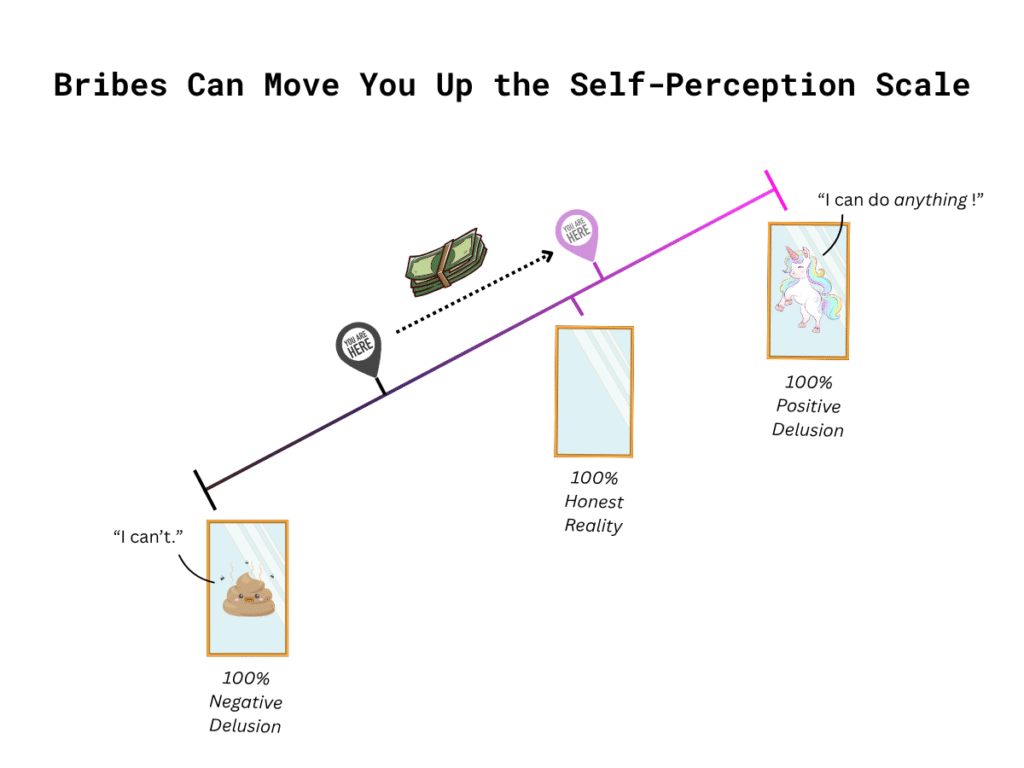
Time to start bribing people a lot more.
My 4-year-old son doesn’t think he can read a whole kid’s book on his own? A giant Pokemon stuffy will show him otherwise.
One of my ARC clients doesn’t think it’s worth asking past clients how she’s helped them? The fear of losing $1,000 is enough to get her to change her mind and turbocharge her self-confidence.
I don’t think it’s worth it to put myself out there more to promote my mission to help unleash human uniqueness? The horror of having to burn $1,000 of my hard-earned cash would light a fire under my butt.
Speaking of burning money, that’s how Liemandt learned the power of bribes. Except in his case it was $1 billion. He has invested that much, and counting, in designing a new education software that helps kids learn ten times faster. They have to get through the curriculum one way or other, so who wouldn’t be eager to use his turbo-speed learning solution?
Most kids, it turns out. About 95% of them.
Only about 5% of kids were intrinsically motivated enough to use Liemandt’s software. The rest prioritized daydreaming, spinning on their chairs, or staring at the clock. Education, he learned, is only 10% how (i.e., his software) and 90% motivation. So Liemandt shifted his focus accordingly. He started bribing his daughter, and others’ kids, to use his software—and realize they’re better learners than they thought they were.
There are limits, of course. Despite what Liemandt’s daughter said, she can’t “do anything.” Even $1 billion wouldn’t be enough to get her into the top 0.001% of that academic assessment. But here’s the thing: I’d rather my kids be positively than negatively delusional. And extrinsic motivation can move them along that spectrum. Adults, too.
So rather than look at extrinsic motivation as “dirty fuel”, like Dan Pink calls it in his book Drive, I now see it as a marketing budget for better identities.
Identities are the clothes we layer on top of our innate frames. “I’m a top 10% student,” “I’m not athletic,” or “I’m not a book reader.” Such identities are like Snuggies, cozy but unflattering and unsuitable for performing to our potential.
Extrinsic motivation is saying, “Hey, I’ll pay you to try this funky new identity on for size while you study/exercise/whatever.”
It’ll feel weird at first, but if it truly fits them better and you get them to look in the mirror and reflect on how it improves their performance, they’ll realize, “Hey, I like this more than my Snuggie.” At which point you don’t need the extrinsic motivation marketing budget anymore.
The risk, of course, is of extrinsic motivation being more like motivational Ozempic. As soon as you cut their supply, they go back to where they started. Two criteria prevent that:
- The new identity has to truly fit and function better than the status quo. (“If my daughter applied herself more, she’d unlock more of her potential.”)
- The individual reflects on and acknowledges this being the case. (“Wow, I did it. I can do a lot more than I thought..”)
The fit doesn’t have to be perfect either, just slightly better suited to their nature.
Come to think of it, this applies to my old “intrinsic motivation purist” identity. It was the opposite of a Snuggie. More like a stuck-up suit. Too tight and restrictive. I’m glad I’ve swapped it out for something looser. I only wish someone had bribed me to give extrinsic motivation a try years ago.
I wish I could afford to offer you $1,000 to try it on for size too. But I guess I can threaten you. Not embracing extrinsic motivation will hold you back. So start bribing yourself and others.
Society sands people smooth. I call it conformity waste.
The Zag is my running investigation into reversing it: decoding what makes you different and putting it to work. I publish what I find every 2 to 3 weeks. Zero spam.

About the author
I’m on an adventure developing better systems for understanding and designing around what makes each of us different. The Zag is where I share what I’m learning.
