

3 Bright Ideas (and 1 Ball) I Found on a Playground
This past week, while visiting family on Vancouver Island, I escaped for a Sunday calisthenics workout at a nearby playground1. Since it was my first alone time in days, I felt a strong urge to decompress my brain with a podcast. But I resisted.
This decision to go headphone-free ended up paying off.
At the playground, as I scoped out the equipment for my exercises, I spotted an abandoned blue soccer on the grass seventy-five yards away. It was chewed-up. But it wasn’t punctured. Good enough to play with.
Hmm…
Sometimes I play around with my volleyball in between workout sets. Why not try with this?
Then, I noticed an empty wall.
Hmm…
Then came my first bright idea:
💡 Maybe I can use this wall and ball for spike practice!
Here’s the thing: I’m 6’3″ and can jump high enough to dunk a basketball, but I can hardly slam a volleyball into the other team’s court because of bad form. These past couple of weeks, I’ve been watching slo-mo videos of pros to devise a better technique. It feels good, but hasn’t helped me in real games yet.
So between workout sets, I spiked the ball against to wall to practice my new swing.
Then came bright idea number two:
💡 Why not record myself?
I’ve only ever seen myself before by practicing my swing in the mirror at home. Hitting a ball instead of flies and being able to watch myself in slow mo would be way better.
I propped up my phone, hit record, spiked a few balls, and watched back.
Yikes.

What I saw did not match what I felt.
I felt like I was swinging like the pros I’d been trying to mimic. But I saw something completely different. Blatantly bad form.
Next time around I tweaked a little. Try to pull my elbow back a lot further.
Recorded. Rewatched. Improvement. But still not good. Elbow higher.
And I continued tweaking, recording, rewatching. By the end of six iterations, I’d made a visible improvement.

That’s when it hit me—my surprise reward for resisting the urge to distract my brain with AirPods and let my mind wander. The answer to my question from the top.
Bright idea number three:
💡Being able to objectively watch back your past performance IN LIFE can clear up delusions between perception and reality and dramatically improve your progress.
This is a big one, so I’ll repeat it:
Being able to objectively watch back your past performance in life can clear up delusions between perception and reality and dramatically improve your progress.
Quit Swinging Away Blindly
Ninety-five percent of us live similarly to me and my volleyball spiking, swinging away with terrible technique, ignorant of the incongruence between their inner perception and the outer reality.
There’s the Helpless Self-Helper:
“I should be better! I have the tools. I’ve studied how. And I feel like I’m doing it right. But something’s not falling into place. I’ll keep studying and practicing.”
There’s the Overconfident Obliviot:
“I’m pretty awesome. I don’t understand why I’m not winning. Must be bad luck or someone else’s fault.”
And there’s the Complacent Opportunity-Misser:
“Why bother trying to improve? I’m doing well enough. It’s not worth the effort.”
All of the above, and you and me, can make dramatic improvements if we record, review, plan adjustments, try again, and repeat.
From Volleyball to Life Mastery
Now, you might be thinking, “This sounds great for volleyball, but how do I apply this to my life?”
Good news: You don’t need to walk around with a GoPro strapped to your head.
To record your life like I did my volleyball swing, all you need is a notebook—physical or digital—to report as objectively as you can:
What did I do today?
Do that daily. Then, at the end of the week, review the past seven days:
- What went well?
- What didn’t?
- How can you tweak to do better?
Plan accordingly. Then try again. And keep fine-tuning:
Do → Record → Review → Plan → Do → Record → Review → Plan → Do → Record → Review → Plan → … and so on.
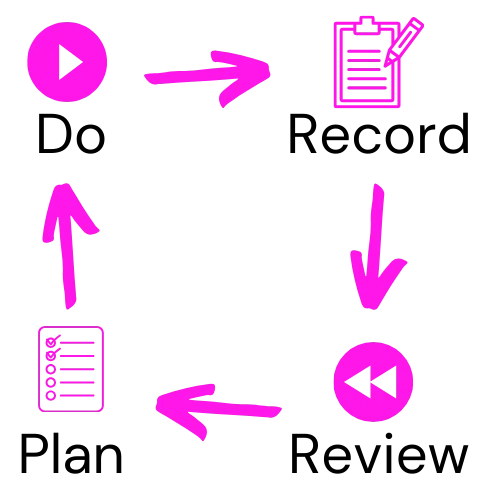
It’s as simple and boring as it sounds. But the results aren’t.
Within a few rounds, you will make improvements to your life as obvious as those I made to my spike swing.
You’ll feel it and see it. And as you progressively develop a less deluded, more honest view of your performance at life, you will:
- Clear away kinks that cause unnecessary stress, faults, and injury.
- Perform more effortlessly and naturally.
- Progress more on what matters most to you.
- Enjoy it all more.
This relates to a pet theory of mine:
The closer you see yourself is to how the outside world sees you, the higher your well-being.2
Bigger Screen, Better Results
For truly extraordinary progress, a weekly Do → Record → Review → Plan cycle isn’t enough.
Zoom out.
At the end of the month, review your weeks.
- What went well?
- What didn’t?
- How can you tweak to do better?
Plan accordingly. Then try again. And keep iterating.
Then zoom out even further.
At the end of the year, review your months the same way.
This broadens you perspective of your time, which I’ve argued is the second best thing you can do for your life.
Some of the benefits:
- Less overwhelm, higher satisfaction in the moment.
- Less urgency and FOMO, more long-term focus on what matters most.
- Less negative emotion, higher resilience.
- Fewer ups and downs, more steady progress.
“Blah, blah, blah Mr. Blachut,” you may be thinking. Ok, how about a more concrete example:
My own Do → Record → Review → Plan → Repeat system is what made me aware that the long-term benefits of letting my mind wander exceed those of listening to podcasts3. Had I stuffed my ears with AirPods last Sunday, I would not have gotten this idea to write to you today. My spike would still be extra crap, too.
And I can give you dozens of more examples. You’ll have read many if you’ve been subscribed for a while.
For these reasons and many more I’ll save for later, my system is so valuable to me that you couldn’t pay me to give it up. It has upgraded not just my volleyball game, but every aspect of my life. From my writing to my relationships, it’s been the key to steady, meaningful, energizing progress—progress that I can feel and see.
Kickstart Your Own System Into Gear
But Chris, if such a Do → Record → Review → Plan → Repeat system is so ‘priceless’, why don’t way more people use one?
The same reasons it took me thirty years to get started: ignorance, busyness, laziness, impatience, short-sightedness, distraction, lack of accountability, poor prioritization….
Incidentally, all problems a Do → Record → Review → Plan → Repeat system helps your improve upon.
It’s a catch-22.
How to circumvent it?
With a kickstart.
That’s why I’m offering personalized coaching to help a select few of you who are serious about implementing your own Do → Record → Review → Plan → Repeat system.
And since I’m new to this coaching stuff, I’m offering a once-in-a-lifetime bargain—one so good you can’t possibly regret it (and if you do, I’ll happily refund you):
- Detailed walk-through of the core system structure I’ve been evolving for nearly ten years.
- At least 3 one-on-one, 30-to-60 minute calls with me.
- Weekly check-ins for accountability.
- Ongoing thought-starters on a private WhatsApp chat.
- Follow ups one, three, six, and twelve months afterward to see how you’re doing and how I can help.
- And anything else I can do to help you succeed so that I can figure out how to make this new coaching program of mine a success.
All for only $200.
Why so cheap?
- I don’t think I have enough testimonials or credibility to charge the thousands of dollars this will be worth. So I need to prove myself first.
- I’m going to lean on you for feedback to help me get better at helping more people implement their own systems for more money.
Interested, but not convinced?
Well, let me save your butt the pain of sitting on the fence so long. Here’s what I recommend:
If my writing and ideas resonate with you, sign up. Even if my attempts to help you kickstart your own system fail (they won’t), the value you’ll gain from our conversations will far exceed the $200 investment. I guarantee I will do everything in my power to make that true.
I only want to work with five people, so if you’re interested, send me an email explaining why and any questions you have.
Or if you’re comfortable on the fence, at least put yourself on the “I’m interested in a more fine-tuned but also more expensive iteration” list here:
And if you’re content with being a Complacent Opportunity-Misser, I nonetheless hope you feel this post was worth reading.
Thanks for doing so.

Footnotes That Don’t Stink
- Working out outside is terribly underrated.
Sure, it’s not as “efficient” or “comfortable” as going to a gym, but ask yourself, what are you working out for? If the answer is to feel and live better, try ditching the gym.
See my posts on the pros and cons of working out outside and my comprehensive guide to natural outdoor workouts for more. ↩︎ - The idea of seeing yourself consistently with how the outside world sees you boils down to being “congruent,” a term coined by Carl Rogers.
Congruence differs from authenticity. You can honestly feel you’re being authentic, but as Richard Feynman says, “The first principle is that you must not fool yourself, and you are the easiest person to fool.” Congruence is decoding what you’re made of, accepting it, and making the most of it. Seeing your reality rather than letting feeling delude you helps you do so.
↩︎ - A reframe that motivates me overwhelm my brain with podcasts (or even music) less and let it wander more:
Target 10,000 mental steps a day.
For me, that means at least 100 daily minutes of distraction free time for my brain.
See the story of how I got started with my 10,000 mental step habit. ↩︎
Society sands people smooth. I call it conformity waste.
The Zag is my running investigation into reversing it: decoding what makes you different and putting it to work. I publish what I find every 2 to 3 weeks. Zero spam.

About the author
I’m on an adventure developing better systems for understanding and designing around what makes each of us different. The Zag is where I share what I’m learning.