

Long Story Short:
Studies show that exposure to religious terms can subconsciously influence behavior, promoting values like generosity. So maybe by creating an “info-ligion” centered on your own values and consuming content that reinforces them, you might better embody those values. I’m experimenting with this idea through “Flip-Flopism.”
Are all of the books, podcasts, newsletters, and articles we consume doing us any good?
I’m becoming increasingly doubtful.
“Readers are leaders,” they say, but I’m starting to believe that’s more correlation than causation. Would you and I be more creative—more ourselves—if we left our brains to their own devices rather than stuffing them with others’ thoughts and ideas?
On that note, are you getting anything positive from reading these words? Probably not, right?
The Information We Consume Affects Us More Than We Think
Driven by doubts about the value my writing provides you, I looked into the possibility of developing certified expertise by enrolling in the Psychology Department at the University of British Columbia here in Vancouver.
During my research, something—a divine force?—but compelled me to read the paper “God Is Watching You” by UBC professor Ara Norenzaya.
In the study, participants were instructed to solve a set of word puzzles. Some participants’ word puzzles contained religious terms like “divine” and “God.” Others’ puzzles contained neutral terms like “butter” and “truck.” A few minutes later, participants were given ten one-dollar coins and asked how many they wanted to keep and how many they wanted to give to a complete stranger.
Incredibly, the participants primed with religious terms gave away 78% more money than their counterparts who were primed with neutral words ($4.60 versus $2.60, on average).
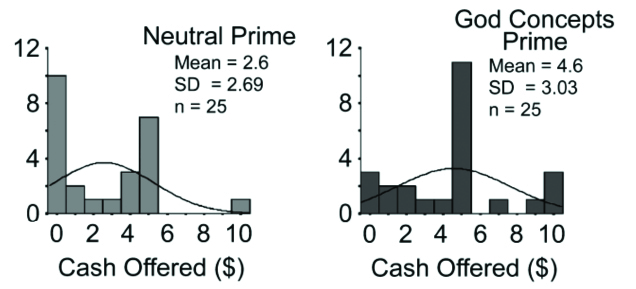
Upon reading this, an enlightening thought flashed in my mind:
Could the books, articles, and podcasts I consume be subtly, if subliminally, affecting my behavior, too?
Or is this just another way for me to justify my unhealthy information overconsumption? Was learning about Norenzaya’s study yet another waste of my time and attention?
The Midnight Message From Above
The night after reading Norenzaya’s study, I finally got my 3-month-old son into a milk coma, read some of my latest brain candy, The Halo Effect1, and started to nod off when…
…FLASH!
A kaleidoscopic burst of clouds materialized from the ceiling. From within them, a talking golden flip-flop levitated down. It radiated in divine light.
“Sup Chris.”
If I hadn’t taped my mouth shut2, my jaw would have dropped.
The flip-flop smiled at me and continued in a voice that sounded a lot like Matthew McConaughey. “I know you think you’re not religious, highly skeptical, and rational. But don’t you believe in me?”
“No,” I mumbled through my mouth tape, while blinking in disbelief and wondering if my mental diabetes had gotten so extreme that it was making me hallucinate. “I don’t believe in you.”
“Well, maybe you might want to try,” the magical sandal chuckled. “You like to think of yourself as being open-minded and adventurous, don’t you?”
“Yeah, but I’m not a lunati…”
POOF!
The flip-flop vanished.
And I fell back asleep.
Could I Create My Own Info-ligion?
Kim laughed the next morning when I told her about my dream. “Haha! Maybe the flip-flop is your god!”
I chuckled with her.
Then I stopped. Wait. What if Kim’s not joking? What if I became a Flip-Flopist?
Could I influence my behavior by brainwashing myself with propaganda that preaches the values I choose to hold sacred?
Could I create my own info-ligion?
The Fundamentals of Flip-Flopism
As I considered Flip-Flopism more seriously, I began to think about its core tenets and symbols.
What could Flip-Flopism’s sacred values be?
- Anti-complacency
- Independent-mindedness
- Curiosity
- Authenticity
- Patience
- Humor
Who or what would be Flip-Flopism’s almighty?
This relates to another piece of Norenzaya’s research, the concept of “watching gods.” When people are reminded of gods watching over them, they tend to act more in accordance with their religious values.
I doubt the being reminded of a divine flip-flop would do the trick for me. But what if, instead, I nominate a celestial board of directors?
I could start with Richard Feynman, Ed Thorp, Arnold Schwarzenegger, my kids, Dr. Seuss, and the tortoise from “The Tortoise and the Hare.” Crazy as that sounds, imagining them watching over my actions motivates me to act in accordance with Flip-Flopist values.

What about symbols?
Christians have the cross. Jews the Star of David. Stoics have Memento Mori coins that Ryan Holiday has made millions from selling.
Flip-Flopists?
Easy: A flip-flop sandal.
As it happens, I already own the perfect symbol. Way back in 2010 when I was working in Corporate Finance in Switzerland, I bought a flip-flop pendant from an EasyJet magazine. Kim begged me to stop wearing it when we got serious. “It’s cheesy! Ugly! Why?” she complained. But now I have a “Why” worth resurrecting my pendant for. It wear it for my info-ligion!
Put the “Be” In Believer
Rather than passively follow Flip-Flopism or actively preach it to others, I intend to walk the Flip-Flopist walk.
That means building up CREDs, Norenzayan’s acronym for “credibility-enhancing displays”: difficult-to-fake actions that demonstrate and reinforce my commitment to Flip-Flopism.
I believe I already embody Flip-Flopist values—flip-flopping between Cape Town and Vancouver, venturing down my own uncertain career path, sleeping on the floor, doing unconventional workouts like rock-throwing, and constantly taking on new challenges.
But I must keep pushing to please the Board and the all-mighty Flip-Flop.

Live True to Your Own Info-Ligion
Thanks to embracing Flip-Flopism, I now believe the information I consume benefits me—so long as it reinforces my values. So I won’t forsake podcasts, books, and blogs. I’ll just be extra careful.
And I will continue to preach ideas that support my Flip-Flopist values to you and anyone who will listen. But my goal isn’t to convert you. It’s to inspire you to consider creating your own info-ligion.
At least consider this:
- What are your sacred values?
- Does the information you consume subliminally nudge you in the right direction?
Most importantly:
- Are you a passive information absorber praying for miracles, or will you be CRED-able, i.e. will you walk the walk?
- The Halo Effect is an excellent book, one of the best I read all year. I recommend it to anyone who likes reading business books. ↩︎
- For more on my mouth taping, see the the story of how I trained myself to stop mouth breathing and breathe through my nose. ↩︎
Society sands people smooth. I call it conformity waste.
The Zag is my running investigation into reversing it: decoding what makes you different and putting it to work. I publish what I find every 2 to 3 weeks. Zero spam.

About the author
I’m on an adventure developing better systems for understanding and designing around what makes each of us different. The Zag is where I share what I’m learning.
